The start of the 2025/26 winter season: What's driving Kässbohrer
Insights into the season opener
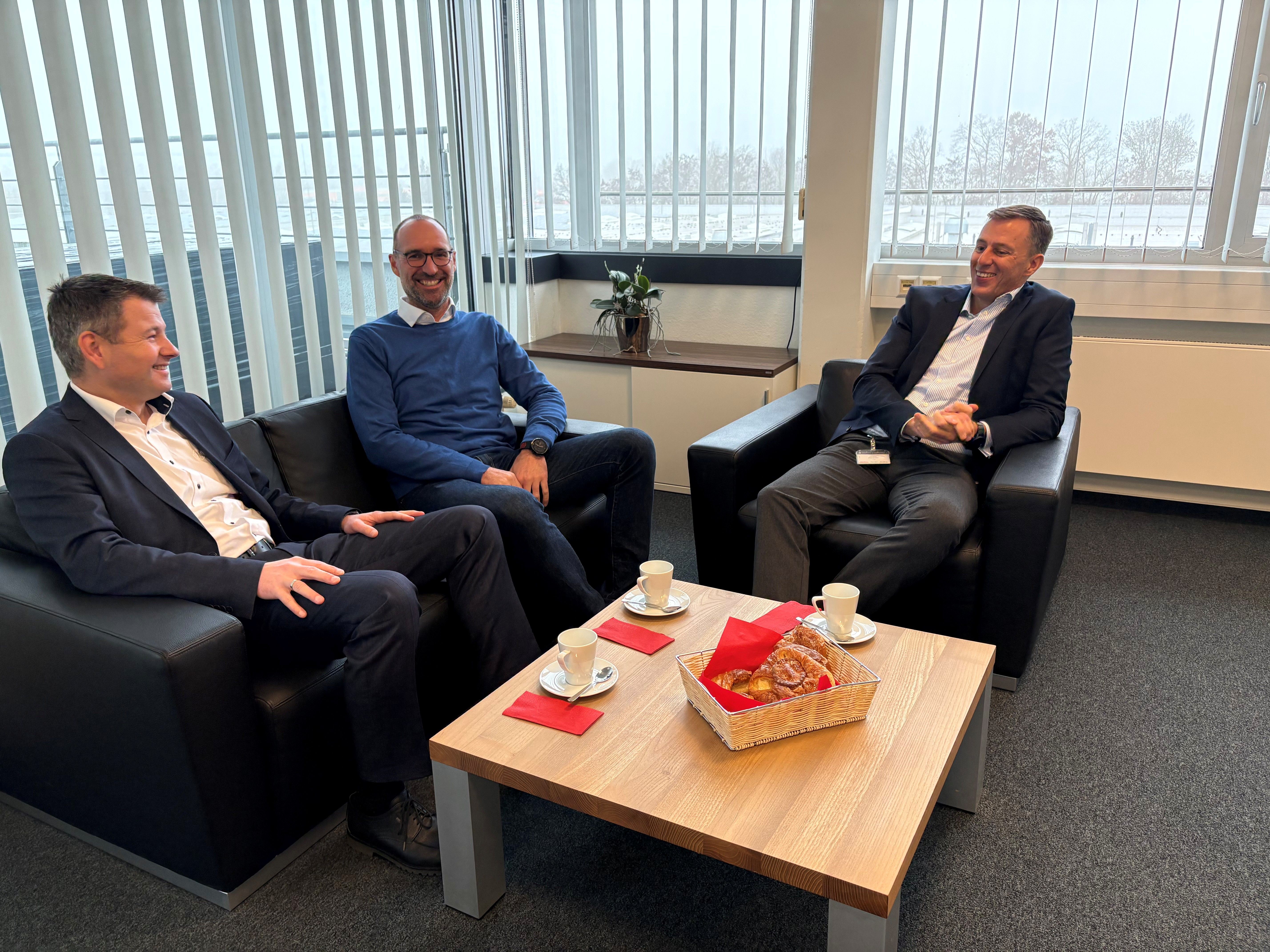
Interview in Laupheim with Heiko Stähle, Alexander Dehm (centre) and Dr. Christian Oberwinkler (from left to right) in December 2025.
Laupheim, December 2025. At the start of the 2025/26 winter season, Dr Christian Oberwinkler (CO), Chief Technology Officer, Heiko Stähle (HS), Chief Sales & Administration Officer, and Alex Dehm (AD), Head of Sales, provide insights into the topics that are currently driving the company – from the intense high season to new everyday requirements to the developments that are currently shaping and occupying the company.
Moderator: The winter sports season has begun. What does that mean for Kässbohrer?
AD: For us, this is the start of the most intense but also the most wonderful time of the year. Many customers are waiting to receive their new snow groomers on time. The window of opportunity before the start of the season is narrow – and everyone in the company is doing their utmost to ensure that the vehicles leave production on time and make it to the slopes.
HS: The Christmas holidays are the most important time of the year for cable car operators, and we also deliver over 60% of our annual sales in the last three months. Strong performance is crucial here. That's why we increase production capacity in the last quarter – with additional weekly hours and Saturday work. Year after year, our team demonstrates impressive flexibility and commitment, because the season never takes a break.
Moderator: In autumn, a general reduction in weekly working hours to 35 hours was agreed in the collective bargaining agreement. Heiko, what were the reasons for this?
HS: This decision is based on several strategically important considerations. Our market is undergoing profound change: geopolitical developments, new tariffs on US exports and a noticeable decline in global market volume are increasingly affecting our business. We must respond proactively to these changes.
The reduction in working hours is therefore part of a comprehensive package of measures with which we aim to regulate potential overcapacity at an early stage. The aim is to avoid more far-reaching measures and to ensure that the company remains stable and competitive in the long term. This difficult decision is therefore an important building block in securing our future.
Moderator: Are there any other measures to strengthen the company's competitiveness?
CO: Yes. Another area of action is the consistent optimisation of our processes. There is considerable potential here that we want to leverage in a targeted manner. This is explicitly about improving processes – not optimising employees.
We are taking a comprehensive look at our processes: from development to purchasing and production to service. At the same time, our customers are also undergoing a phase of intensive transformation: digitalisation, networking and efficiency gains are increasingly shaping their everyday lives. Only those who actively embrace these developments will remain successful and viable in the long term.
Moderator: Christan, you talk about digitalisation, efficiency and networking – both internally and with customers. Does that mean that organisational development is also relevant for market success?
CO: Ultimately, what counts most for our customers is the result: the perfect slope. But better internal processes ensure that we can deliver faster, in a more structured and reliable manner. This helps our customers with planning, cost-effectiveness and quality – which is why modern working time models, efficiency and process optimisation are just as much a part of product development for us as technical innovations. Ultimately, this has an impact on market success.
Moderator: What progress has been made in terms of quality?
CO: Over the past two years, we have invested heavily in improving our quality and critically reviewed our development processes. Feedback from our customers confirms that we are on the right track. Our service and quality offensive has also been very well received. As the market leader, it was important for us to take responsibility here and actively drive improvements in the field.
Moderator: Kässbohrer is considered an innovation leader. How do you substantiate this claim?
AD: Innovation means real improvements to products, procedures and processes with the sole aim of creating customer benefits. We have taken important steps with the electrification of our fleet: the PistenBully 100E will be available on the market from this season onwards. The PistenBully 600 E+ is a very popular vehicle and is making a big impact. The first vehicles with KFX have already been delivered. KFX makes slope preparation even more efficient and economical, while conserving resources and materials – and improving slope quality. These are exactly the kinds of solutions our customers need to offer perfect slopes every day. That's innovation!
HS: These developments contribute directly to our sustainability strategy: efficient use of resources means economic and also more sustainable action. In this way, we support our customers in achieving their own sustainability goals. We want to take the lead here too.
Moderator: In addition to the sustainability strategy you mentioned, is there also an overall strategy to strengthen the company's future viability?
CO: Yes, absolutely – that is a key point. Over the past year, we have worked with a great deal of energy and drive on our new corporate strategy, K-next! Colleagues from all areas and our subsidiaries have made valuable contributions. Our customers, partners and proven winter sports experts have also provided valuable input that has been directly incorporated into the strategy. Together with experts from related and even unrelated industries, we have deliberately broadened our view beyond the mountains and slopes. This has resulted in a diverse mix of perspectives, ideas and experiences that will help us to position Kässbohrer successfully and sustainably for the future. Our strategy is based on several tracks that we intend to successfully implement by 2030. We have already started with the first measures.
Moderator: There have been some changes in the senior management team.
CO: Indeed. After 35 years at Kässbohrer, Raimund Mayer is retiring. For many years, he was the defining face of our TOP service worldwide and achieved great things for our company. With his attitude, reliability and deep understanding of our customers' needs, he built trust and forged relationships that went far beyond everyday work.
We are taking these changes as an opportunity to review our structures. We will optimise this area to become even better.
Christof Peer has left the company for family and personal reasons. His responsibilities will be divided among the members of the Executive Board: in addition to technology and production, I will take over product management, technical service and the Pro Academy.
HS: I am looking forward to meeting many customers in person in the new year, as I am now taking on sales and marketing in addition to my previous responsibilities. Our close cooperation with our customers has been the basis of our success for decades.
I would also like to express my sincere thanks to Raimund for his many years of valuable work. Changes like this are part of the process – our team is experienced and stable enough to continue seamlessly.
We would also like to take this opportunity to express our sincere thanks to our employees. They not only support the paths we have already taken but also accompany us on new paths that lie ahead. Precisely because some decisions and measures are difficult or challenging, we particularly appreciate this commitment. This willingness is anything but a matter of course and deserves our great respect and gratitude.
Moderator: Thank you very much for the insightful comments and your time! We hope that the 2025/26 winter season will be a successful one for all of us.

